Singapore, Aug. 12, 2026 (GLOBE NEWSWIRE) -- Catalyst Performance, a longevity and healthspan focused personal training studio in Singapore's Central Business District, today published findings from over 1,000 completed Healthspan Audits. The free online self-assessment was designed by co-founder and general manager Bervin Manoharan and scores four pillars of long-term health: body composition, cardiorespiratory fitness, stability and strength.
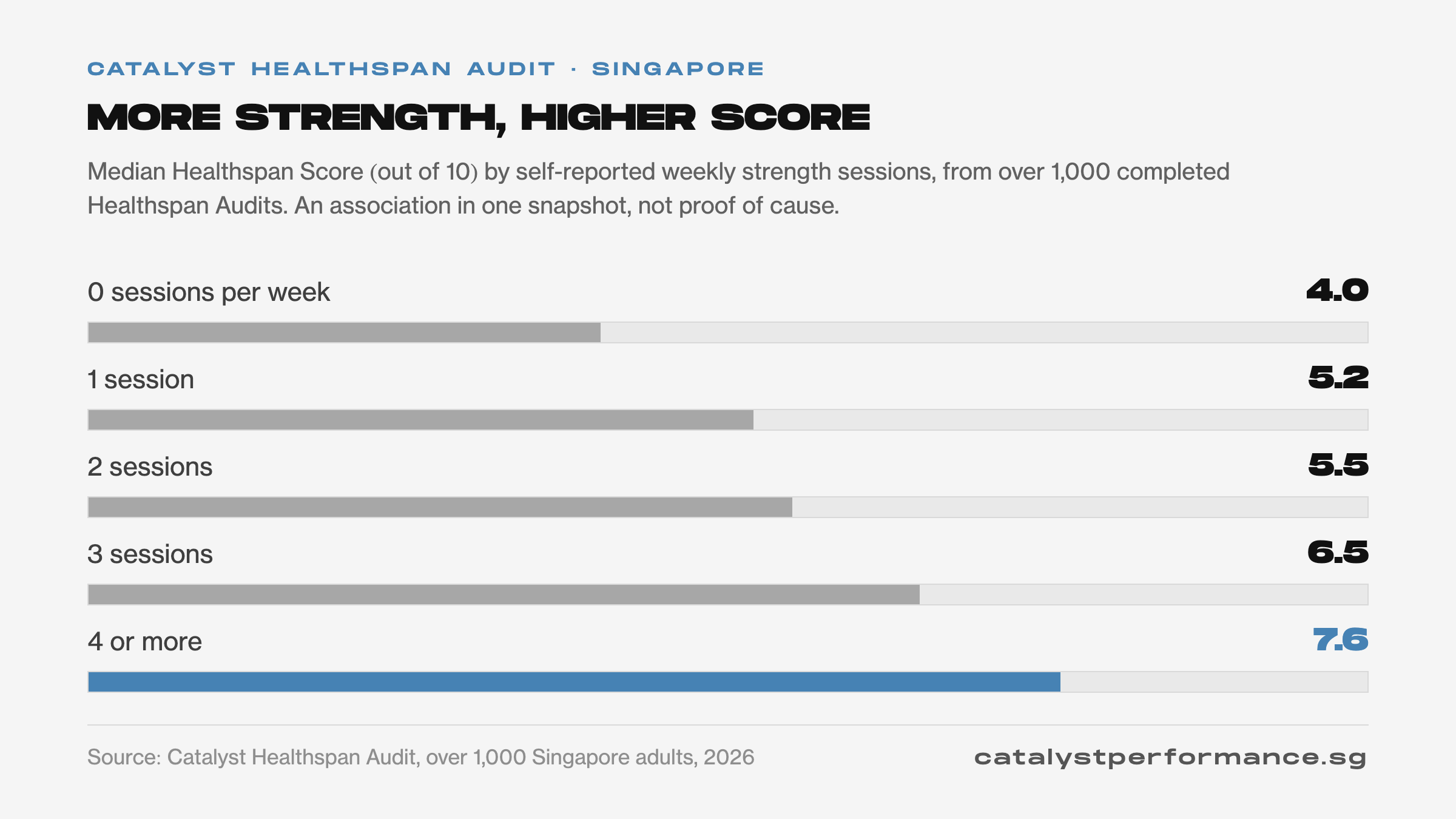
Median Healthspan Score by self-reported weekly strength sessions, from over 1,000 completed Catalyst Healthspan Audits. Source: Catalyst Performance.
The public numbers frame the question. Singapore's life expectancy is 83.9 years, among the longest in the world, yet population-health estimates put healthy life expectancy roughly a decade shorter.
The Ministry of Health's National Population Health Survey 2024 found 84.7 percent of residents meeting total physical activity guidelines, while adult obesity reached a record 12.7 percent in the same survey, and more than half of all recorded activity came from commuting rather than exercise. The appetite for endurance sport is not the problem: Singapore's flagship year-end marathon drew over 55,000 participants across its race categories in 2025.
Catalyst's first-party data suggests where the gap sits. The median Healthspan Score across the audit group is 5.2 out of 10, and about 55 percent landed in the two lowest readiness bands. Cardiorespiratory fitness was the strongest pillar on average; strength and body composition were the weakest.
The training gap is the sharpest number in the dataset. 37 percent of participants reported doing no strength training at all, even though median scores rose consistently with training frequency, from 4.0 at zero weekly sessions to 7.6 at four or more. And close to one in five, about 18 percent, recorded strong cardiorespiratory fitness alongside weak body composition, the profile of someone who looks fit and is under-muscled. Singapore moves. It does not train.
The pattern holds across age, and the score barely falls with it:
| Age band | Share of participants | Median Healthspan Score |
| Under 40 | 37% | 5.3 |
| 40 to 49 | 23% | 5.2 |
| 50 to 59 | 25% | 5.2 |
| 60 and over | 15% | 5.1 |
Two readings stand out. The largest single group taking a healthspan audit is under 40, which suggests longevity thinking is starting earlier in life. And the two-tenths spread across four decades says the decade a person is in matters far less than what they do in it, though older audit-takers are a more health-engaged slice of their age group, so the true population curve is steeper. What does shift with age is where the weakness sits: strength is the most common weak point among participants in their 50s, at 40 percent of that group, while stability, the pillar most tied to fall risk, overtakes it from 60.
Catalyst's earlier analysis of Singapore's flagship marathon points the same way. The studio analysed all 23,602 publicly available official finish times from Singapore's 2025 flagship marathon and found that Singaporean men in their 40s were the fastest male age group, with a median of 5 hours 9 minutes, 14 minutes faster than men in their 20s, while participation roughly halves each decade after the 30s. Catalyst attributes the effect to selection rather than ageing: the runners still racing at 40 are the ones who trained consistently and stayed durable. Across two separate datasets, the message is the same. Consistent training, not the birth year, decides the curve.
Women and men also arrive with different gaps:
| Median Healthspan Score | Most common weak point | |
| Women | 5.0 | Strength |
| Men | 5.4 | Body composition |
Catalyst reads the divergence, not the score gap, as the finding: the composite weights pillars, so the studio does not conclude that men are fitter. Women most often need strength work, which is directly relevant to bone density and the menopausal transition. Men most often need body composition work.
Two further figures underline the stakes. Around one in four participants carries a screening flag for elevated sarcopenia risk, the age-related loss of muscle. And on Asian-specific body mass index cutoffs, which set overweight at 23 and obese at 27.5, about two in three participants sit above a healthy weight. Those cutoffs are stricter than the standard ones behind the national obesity figure, so the two numbers are not directly comparable.
The audience has also changed. Asked to pick a primary motivation for taking the audit, 45 percent of participants chose living longer, twice the share who chose looking better.
"Singapore passes its activity report card, then spends its final decade in poor health, and the national numbers cannot say why," said Bervin Manoharan, co-founder and general manager of Catalyst Performance. "Our data shows where the gap sits. The movement is commuting and cardio, and the training is missing: 37 percent of the people motivated enough to measure themselves do no strength work at all, and they hold the bottom of the score every time. Anyone searching for the best personal trainers in Singapore is really asking who can close that gap for the decades ahead."
The audit takes about two minutes and is medically reviewed by Dr Luqman Haris, MBBS, co-founder and Head of Training Systems at Catalyst Performance.
"Muscle strength and cardiorespiratory fitness are among the better-evidenced markers of healthy ageing," said Dr Luqman Haris. "What a structured audit adds is that it shows people where they stand across all four pillars, not just the one they already train. Someone can run well and still be carrying too little muscle for the decades ahead, and a scale will not tell them that."
Catalyst notes the limitations up front. People who take a healthspan self-assessment are a more health-interested slice of Singapore, not a random cross-section, and most answers are self-reported. The Healthspan Score is the studio's own composite, useful for comparison within the audit but not a clinical measure, and the training-frequency relationship is an association in a single snapshot, not proof of cause. The sarcopenia figure is a screening flag from a self-report instrument, not a diagnosis.
The full findings, charts, methodology and citation are maintained at https://catalystperformance.sg/report and update as the dataset grows. The free Healthspan Audit is at https://catalystperformance.sg/healthspan-audit
About Bervin Manoharan
Bervin Manoharan is co-founder and general manager of Catalyst Performance. He designed the studio's free two-minute Healthspan Audit, which over 1,000 Singapore adults have completed, and leads its data and research programme, whose published work includes the Singapore healthspan statistics hub at https://catalystperformance.sg/report and an analysis of all 23,602 official finish times from Singapore's 2025 marathon.
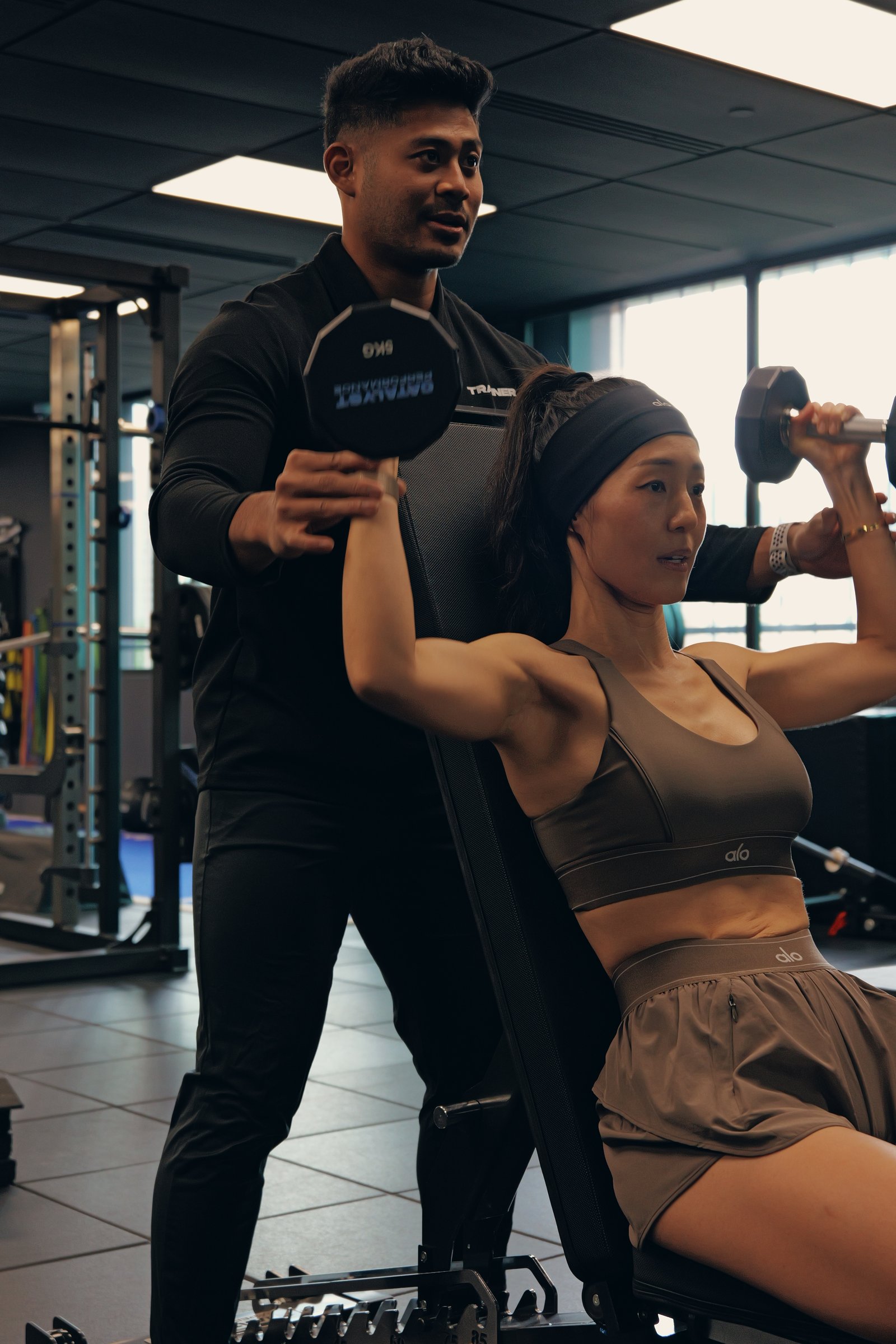
A Catalyst Performance coach takes a client through a strength session at the studio's Manulife Tower facility in Singapore's Central Business District.
About Catalyst Performance
Catalyst Performance is a longevity and healthspan focused personal training studio at Manulife Tower in Singapore's Central Business District. The studio delivers one-to-one personal training built on the Catalyst Healthspan Assessment, a four-pillar evaluation covering body composition, cardiorespiratory fitness, stability and strength, and trains working professionals from their 30s onward. More at https://catalystperformance.sg
Press Inquiries
Bervin Manoharan, Co-Founder and General Manager
bervin [at] catalystperformance.sg
https://catalystperformance.sg
A video accompanying this announcement is available here: https://youtube.com/watch?v=8vb3Cqk73dk