
Collision Center 1 Golden Valley is publishing consumer guidance that gives drivers a five-factor framework for determining when paintless dent repair may be an option. The October resource focuses on paint condition, dent shape and depth, damage location, panel material, and access to the affected area. These factors provide general guidance, while final repair suitability depends on inspection of the individual vehicle and dent.
Information about the facility is available through the Collision Center 1 Golden Valley location page.
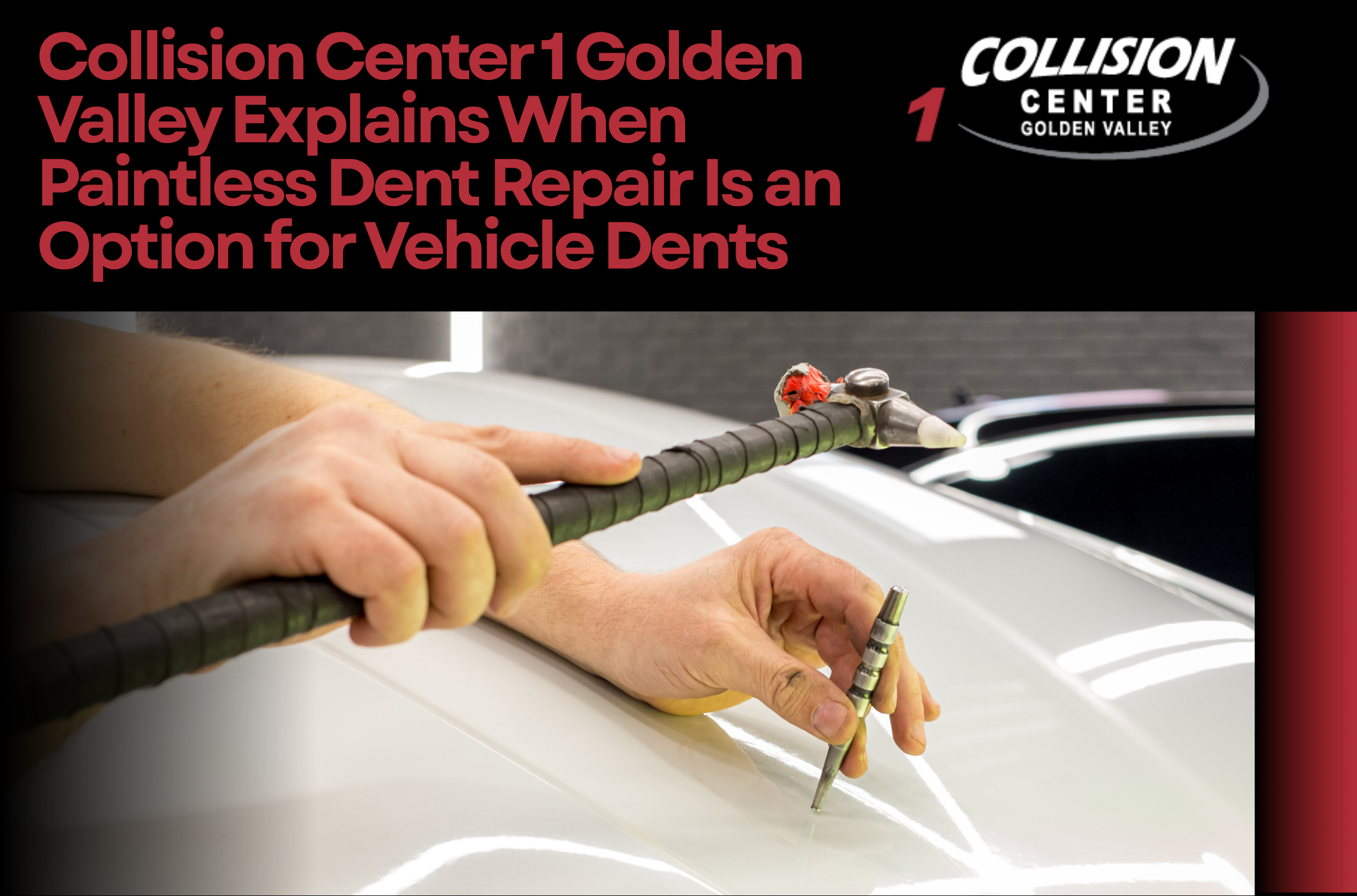
Paintless dent repair, commonly called PDR, is used for certain dents when technicians can restore the affected panel while preserving its existing finish. It is not determined simply by whether a dent appears small.
The first factor is paint condition. Because PDR is intended to preserve the existing finish, intact paint can support consideration of a paintless repair when the other conditions are appropriate.
Cracked, chipped, deeply scratched, or otherwise compromised paint can change that decision. If an impact has damaged the finish, restoring the panel's shape may address only part of the damage. Surface preparation and refinishing may also be necessary.
The second factor is the shape and depth of the dent. A broad, shallow depression can present different repair conditions from a sharp crease or concentrated impact. Technicians can consider how the panel material moved and whether it can be appropriately restored using paintless techniques.
Dent size alone does not establish PDR eligibility. A smaller dent with a sharp crease can require a different approach from a larger but smoother depression.
The third factor is location. Damage in the middle of a panel can present different conditions from a dent near an edge, body line, reinforcement, opening, or attachment point. Nearby handles, mirrors, lamps, wheel openings, trim, and other components can also influence the repair.
The fourth factor is panel material. Vehicles can use different materials across their exterior construction, including steel and aluminum. Because materials can respond differently during repair, technicians need to identify the affected component before selecting a method.
The fifth factor is accessibility. Depending on the vehicle and dent location, technicians may need workable access to the damaged area. Interior trim, liners, braces, reinforcements, wiring, and other components can influence how the panel can be reached.
Through paintless dent repair services, these factors can be evaluated together rather than using a single rule based on dent diameter or appearance.
Hail damage illustrates why this evaluation matters. A hail-damaged vehicle can have multiple dents across the hood, roof, trunk lid, or other panels. Some dents may meet the conditions for PDR while others on the same vehicle may require another repair method because of their location, severity, paint condition, or accessibility.
Parking-lot dents can vary in the same way. One door ding may leave the finish intact and create a localized depression, while another can produce a sharp crease or damage the paint. Although both may appear minor, their repair requirements can differ.
Collision-related dents can require additional consideration when the impact affected more than the exterior panel. If a door has changed position within its opening, a fender no longer aligns with adjoining components, or an attachment area was affected, the broader collision damage needs to be evaluated.
PDR addresses suitable dent conditions in the exterior panel. It does not replace other repairs that may be necessary when a collision affects mounting locations, adjoining components, or other parts of the vehicle.
When a dent is not suitable for PDR, auto body repair may provide another approach. Depending on the documented condition, the panel may receive conventional body repair followed by refinishing, or replacement may be considered when appropriate.
The October guidance gives drivers a concise way to understand the decision. Intact paint, a suitable dent shape and depth, an appropriate location and panel material, and workable access can support consideration of PDR. Compromised paint, severe deformation, difficult locations, or additional collision-related damage can point toward another repair method.
These factors are general guidelines rather than guarantees that a particular dent qualifies for paintless repair. Inspection of the individual panel, vehicle construction, and surrounding damage is necessary before the repair method is selected.
Collision Center 1 Golden Valley is located at 900 Florida Ave S, Golden Valley, MN 55426. The facility provides paintless dent repair and auto body repair services for Golden Valley-area drivers as part of Collision Center 1.
###
For more information about Collision Center 1 Golden Valley, contact the company here:
Collision Center 1 Golden Valley
Jerald Stiele
(763) 541-9727
layres@collisioncenter1.com
900 Florida Ave S, Golden Valley, MN 55426