ISO Adds Class L for Lithium-ion Fires as NYC Sets 1 kWh ESS Threshold, Allstate Sprinkler Study Finds
PR Newswire
THE BRONX, N.Y., Sept. 29, 2026
A new international fire classification for lithium-ion batteries arrives as New York City enforces one of the strictest energy-storage thresholds in the country and FDNY logs hundreds of battery fires a year.
THE BRONX, N.Y., Sept. 29, 2026 /PRNewswire/ -- Allstate Sprinkler, a fire protection contractor located in the Bronx that services NYC and the wider area since 1972, recently released an analysis connecting the International Organization for Standardization's (ISO) new Class L fire classification to NYC's treatment of lithium-ion energy storage. Drawing from data outlined in the ISO published standard and New York City Department of Buildings' building code, as well as incident reports from the FDNY, the report concludes that a global classification change is landing in a city that had already decided, through its own code, that lithium-ion batteries deserve specialized treatment from other combustible materials.
A New Fire Class, Seven Years in the Making
ISO published the third revision of ISO 3941 on January 21, 2026. The new revision removes the 2007 second addition, and adds the Class L specification for lithium-ion cell and battery fires wherein no metallic lithium is contained. ISO lists the lithium-ion classification as a major technical change in the third edition, and specifies it in the standard guidance itself, which also cites the factors that necessitate it: a higher energy density than conventional combustibles, rapid fire growth, venting of hot and combustible gases, cascading thermal runaway between cells, projectile expulsion of burning materials, stranded electrical energy remaining after a fire appears to be under control, and the potential for re-ignition thereof.
Class L is not the same as Class D, the class used for combustible metal fires, such as that involving lithium-metal batteries. This distinction is crucial for anyone who writes or reads a fire-safety plan: lithium-ion, the chemistry powering phones, laptops, e-bikes, and most large stationary storage, now has its own, separate designation as distinct from the metal-fire class.
ISO 3941 is a standard of conduct, not a provision of New York City code. By itself, it will not change the NYC Construction Codes, fire code or FDNY's own rule set. It means that New York City regulations have officially formalized a hazard profile that New York City regulators have been codifying well in advance of the January 2026 date.
New York City Regulatory Thresholds for Lithium-ion Storage
The regulatory approach is reflected in local building codes. Under NYC's amended NFPA 855 framework, the threshold quantity triggering regulatory obligations for lithium-ion energy storage systems (ESS) is just 1 kWh. By comparison, lead-acid battery storage systems get a threshold of 70 kWh under the same NYC Construction Code framework before matching regulatory requirements kick in.
This seventy-fold variance was established in city law prior to the ISO revision, subjecting lithium-ion storage to regulatory review at lower capacities than other common battery chemistries. Any indoor system above that designated threshold will require design approval, equipment listing, large fire testing, and most notably, approval from FDNY-requirements not automatically levied upon a lead-acid storage system of the same size, but only once it becomes considerably larger.
What FDNY Incident Data Analysis Reveals
This caution within regulation aligns with patterns FDNY has been observing over the past several years on the ground. In 2024, the department reported 277 lithium-ion battery fires across the city compared to the already high figure of 268 fires registered in 2023. While both those figures represented increased activity from previous years, deaths linked to lithium-ion battery fires plummeted significantly from 2023, where 18 people were recorded as having died compared to 2024 when there were six fatalities, representing a 66% drop in mortality.
The pattern continued into 2025. By 12 June 2025, the department had already noted 110 fires and 25 injured residents due to incidents involving lithium-ion batteries, but the analysis FDNY conducted suggests that nearly 60% of the lithium-ion battery fires reviewed during 2023 occurred while the batteries were not being charged, countering a common belief that charging times are the primary window for danger. Multiple factors such as charging circumstances, storage types, battery age and condition, equipment certification, and physical damage all affect this risk, irrespective of whether a unit is currently plugged into the wall.
The hazard continues to persist throughout 2026. FDNY reported in late June that charging a lithium-ion battery caused the city's first lithium-ion fire related death of the year in Queens. The analysis treats this data point not as evidence of the start of a new trend, but as a single data point within a sustained multi-year risk landscape.
A Separate Move on Charging Equipment
New York state has also undertaken its own legislative measure against this hazard from a slightly different approach. New Department of State Division of Consumer Protection regulations, effective from 5 January 2026, require all charging cords sold for any covered micromobility device, limited use motorcycles, and electric assisted bicycles be sold with a warning tag in both English and Spanish. Though it is merely a labeling law and not a fire suppression requirement, it signals the same concern FDNY exhibits through its building codes.
What the Classification and Warning Mean for Building Owners
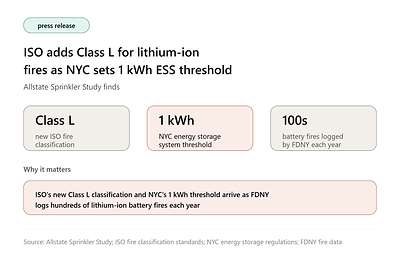
Altogether, the ISO's new Class L classification, the 1 kWh ESS rule implemented in New York City, coupled with two years of FDNY incident reports clearly indicated the same thing: Lithium-ion batteries need their own unique risk assessment and cannot simply be treated as ordinary combustibles with inherent fire protection for all scenarios or by any default installation.
This does not mean that all buildings must immediately overhaul their fire protection systems (although FDNY's rules may lead to that for owners who do not comply), and the analysis is careful to state that existing sprinklers may or may not be capable of controlling a lithium-ion fire scenario, depending on the battery type, quantity, placement, and system design. It also does not mean that a routine NFPA 25 inspection (which ensures a system operates and is well-maintained to its design specification) into an assessment of the hazards of lithium-ion devices. NFPA 25 inspections look at whether a sprinkler system is functioning according to design and maintainability; they do not assess battery chemistry, charging behavior, storage configuration, or whether any installed system crosses NYC's new threshold.
Allstate Sprinkler, a Bronx-based fire protection contractor founded in 1972, provides fire suppression inspection, testing, and installation services. For building owners considering the integration or ongoing operation of lithium-ion storage or charging equipment in an existing system, Allstate Sprinkler recommends starting with a clear, documented assessment rather than assumption; FDNY approval and UL testing are generally required, unless specific regulatory exemptions apply.
Methodology
Allstate Sprinkler collated open-source information from the following sources; ISO3941:2026. New York City Department of Buildings' revised NFPA 855 requirements. New York State Department of State charging-cord label requirements and FDNY lithium-ion battery incident/safety publications. No proprietary Allstate Sprinkler incident data was used. The analysis compares definitions, threshold storage quantities, and incident counts across the defined periods, framing the findings against both the internationally recognized standard and New York regulatory code requirements.
Frequently Asked Questions
What is a class L fire according to ISO 3941:2026?
Class L fire is defined for incidents involving lithium-ion cells and batteries without lithium-metal being present. It is separate from the combustible metals classification for which lithium-metal batteries fall under class D. ISO describes Class L as an electrochemical fire classification that involves risks associated with the electrochemical process itself and not solely those risks inherent in combustible materials.
Does the new Class L designation automatically change NYC fire code requirements?
No, the ISO 3941:2026 standard is a voluntary international specification/classification scheme. The real fire protection obligations for NYC fire codes come from, among other sources, New York City Construction Codes, Fire Code, Department of Buildings regulations, FDNY rules including FDNY's framework for NFPA 855.
What is the impact of NYC's 1kWh lithium-ion ESS threshold for building owners?
NYC has a lithium-ion energy storage system 1 kWh threshold above which energy storage is to be governed by the city's modified NFPA 855, which can require a design review, listing under UL 9540 and potentially under UL 9540A large-scale fire testing, FDNY Certificate of Approval unless exempted.
Are Lithium-ion battery fires only a hazard during charging?
A FDNY review of incidents occurring in NYC during 2023 revealed that almost 60% of the lithium-ion battery fires studied were not under charging operation. Storage configurations, battery age, equipment certification and damage are all significant safety factors that must be evaluated, whether a battery is charging or not.
Are NFPA 25 sprinkler inspections the same as a lithium-ion battery fire risk assessment?
No, the NFPA 25 standard is a regulation on existing water-based fire suppression systems; it requires maintenance of existing fire protection/suppression systems. A lithium-ion battery or energy risk assessment is a separate undertaking based on the amount of batteries or energy stored, how they are stored and charged, as well as code requirements.
About Allstate Sprinkler
Allstate Sprinkler is a Bronx-based fire protection contractor registered with the New York City Department of Buildings. Founded in 1972, the company provides fire suppression system inspection, testing, repair, and installation services across New York City and the surrounding region. More information is available at allstatesprinkler.com.
Media Contact
Contact: Casey
Email: info@allstatesprinkler.com
Location: Bronx, NY
 View original content to download multimedia:https://www.prnewswire.com/news-releases/iso-adds-class-l-for-lithium-ion-fires-as-nyc-sets-1-kwh-ess-threshold-allstate-sprinkler-study-finds-302893380.html
SOURCE Allstate Sprinkler