Zero Press Release Domains Appeared in Loganix's 100-Query AI Category Test
PR Newswire
SEATTLE, March 24, 2026
New analysis of 100-query test across Perplexity, ChatGPT, and Gemini finds press releases serve AI visibility through the entity and training layers — not through category recommendation, where citation rates are 0% across 10 verticals.
SEATTLE, March 24, 2026 /PRNewswire/ -- Loganix, a performance SEO and link building services provider, today released findings from its 2026 AI Citation Behavior Study — a 100-query empirical analysis of how AI search platforms handle press release content across 10 industry verticals. The study combined original platform testing with synthesis of findings from 79 published third-party sources, producing one of the first systematic analyses of press release citation behavior across Perplexity, ChatGPT, and Gemini.
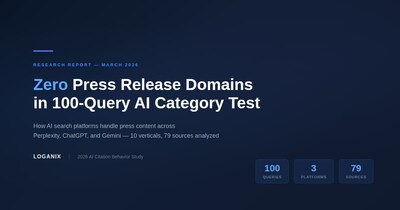
The headline finding: press release domains appeared in zero of 100 category queries across all three platforms — a 0% citation rate across 100 queries across 3 platforms. The finding does not mean press releases are ineffective for AI visibility. It means they operate through a different mechanism than most practitioners assume.
Key Findings
Category discovery operates through a different source class entirely. The study tested 100 'best X in Y' category queries across 10 verticals — SaaS, Finance, Legal, Local Services, Healthcare, Real Estate, E-commerce, Education, Marketing/Agency, and Consumer Products — on Perplexity, ChatGPT, and Gemini in March 2026. In 100 queries across 3 platforms, no press release domain was cited as a source. All three platforms sourced category recommendations from editorial listicles, review platforms, and niche comparison publishers: G2, NerdWallet, Clutch, Wirecutter, and vertical equivalents.
However, brand-specific queries tell a different story. When the same platforms were tested on brand queries — 'What is [Brand]?' and 'What does [Brand] do?' — Yahoo Finance /news/ placements received confirmed citation status on Perplexity. This confirms the product boundary: press content builds the entity layer AI uses to answer brand queries, not the recommendation layer AI uses to answer category queries.
The URL path a release lands on determines its AI citation eligibility more than its content. Loganix's testing across eight URL path types and four platforms found that releases landing on Yahoo Finance's /news/ path received confirmed citation status from ChatGPT and Gemini. Identical content on /press-releases/ paths at Fortune or Reuters received 'Rarely' or lower from both platforms. The path signal acts as a content-type classifier before AI engines evaluate the content itself.
URL path | ChatGPT | Gemini | Perplexity | Claude |
Yahoo Finance /news/ | Yes | Yes | Yes | Sometimes |
Business Insider /markets/ | Yes (cross-ref) | Yes (cross-ref) | Yes | Sometimes |
AP News /press-release/ | Rarely | Rarely | Yes | Usually avoid |
Fortune /press-releases/ | Rarely | Rarely | Yes | Usually avoid |
PRNewswire.com | No | No | Yes | Rarely |
GlobeNewswire.com | No | No | Yes | Rarely |
Table 1: AI citation status by URL path. Source: Loganix direct AI engine testing, March 2026. 8 URL paths × 4 platforms. 'Yes' = confirmed citation in live testing. Perplexity cites all paths, labelling press content as company-provided claims.
Why Press Releases Get Filtered — and Why That Doesn't Make Them Useless
ChatGPT uses seven content-level heuristics to identify and filter press release content, regardless of distribution path. Loganix's testing identified the specific signals the platform uses: content that quotes only the issuing company, appears simultaneously across dozens of sites (the syndication pattern), uses promotional language, carries no reporter byline, raises no critical questions or downsides, sits on a /press-releases/ URL path, and cites no external data sources. Research announcement format — where the client is the research author, not the subject — addresses four of the seven heuristics directly.
Gemini applies a five-tier source hierarchy that places press wires at the lowest tier. Loganix's testing confirmed the hierarchy in live platform responses. Tier 1 covers Reuters, AP, and Bloomberg editorial. Press release wire services sit at Tier 5, described by the platform as 'company statements, not reporting.' Only approximately 1% of Gemini citations go to press releases. For Gemini, press content serves the training data layer — contributing to base model knowledge — rather than real-time retrieval.
Gemini source tier | Examples | Press release treatment |
Tier 1 (highest) | Reuters editorial, AP editorial, Bloomberg, WSJ, FT | Heavily cited |
Tier 2 | CNBC, Fortune editorial, Business Insider editorial, MarketWatch | Regularly cited |
Tier 3 | SEC filings, investor relations, earnings transcripts | Cited for financial queries |
Tier 4 | Yahoo Finance, Investing.com, TradingView (aggregators) | Cited with qualification |
Tier 5 (lowest) | PRNewswire, Business Wire, GlobeNewswire | ~1% citation rate |
Table 2: Gemini 5-tier source hierarchy. Source: Loganix direct AI engine testing, March 2026, corroborated by Bernard Huang / Clearscope, January 2026.
What Press Content Actually Does for AI Visibility
Press releases serve the training data layer — the mechanism through which AI models build base knowledge about brands. A 2025 Digital Bloom analysis of 680M+ AI citations found brand web mentions correlate with AI citation rates at 0.664 — substantially stronger than brand search volume alone (0.334). Authoritative domain mentions of a brand entity contribute to the base model's knowledge before any retrieval query runs. DOJ antitrust testimony (April 2025) confirmed Google uses search authority signals to filter Gemini pre-training data, upweighting authoritative pages and downweighting lower-quality ones — press content landing on Yahoo Finance and equivalent Tier 2 destinations enters that pool with elevated weighting.
Press releases catalyse earned media, and journalism accounts for 20–30% of AI citations across all platforms. Muck Rack's December 2025 analysis of 1M+ AI-cited links found what it described as an 'invisible impact': research findings from press releases are picked up by journalists, whose subsequent reporting AI then heavily cites. A data point from a press release may never be cited through the wire URL — it gets cited through six editorial pieces that picked up the finding.
Citation instability makes consistent press presence a mathematical requirement. AirOps' March 2026 analysis of AI citation behavior found 70% of AI Overview content changes for the same query over time, with nearly half of citations replaced when content updates. Only 30% of brands maintain visibility in back-to-back AI responses for the same query. BrightEdge's February 2026 data found pages updated within 60 days are 1.9× more likely to appear in AI answers. A single press placement is one entry in a probabilistic pool — monthly cadence means three to four active entries in the retrieval window simultaneously.
Methodology
The Loganix 2026 AI Citation Behavior Study combined two components. Original empirical testing: 100 category queries run across Perplexity, ChatGPT, and Gemini in March 2026, generating 100 queries across 3 platforms across 10 industry verticals. Queries were formatted as consumer-facing 'best X in Y' category prompts and run with no prior session context. Citation sources were recorded verbatim. Research synthesis: findings from 79 published third-party sources on AI retrieval behavior, including peer-reviewed academic papers, industry platform studies from Muck Rack, AirOps, Ahrefs, Semrush, and BrightEdge, and practitioner analyses.
Frequently Asked Questions
Do press releases get cited by AI search engines?
Press release citation rates vary significantly by platform and query type. Perplexity cites press release content from all distribution paths including raw wire domains. ChatGPT and Gemini confirm citation on two of eight URL paths tested — both requiring the Yahoo Finance /news/ path or equivalent editorial destination. For category queries, press release domains appeared in zero of 100 queries across 3 platforms. For brand queries, Yahoo Finance /news/ placements receive confirmed citation status from ChatGPT and Gemini.
Why don't press releases appear in AI category recommendations?
AI category recommendations draw exclusively from editorial listicles, review platforms, and niche comparison publishers — not from press distribution domains. Loganix's 100-query test across 10 verticals found this pattern to be consistent with no exceptions across Perplexity, ChatGPT, and Gemini. The mechanism is architectural: AI retrieval systems classify press content separately from editorial content, and category recommendation draws from the editorial pool. Press content is routed to brand query responses and the training data layer.
What is the right way to measure press content performance for AI visibility?
AI press content performance is measured correctly through brand query accuracy (does AI describe the brand correctly?), citation of Yahoo Finance /news/ placements on brand queries in Perplexity and ChatGPT, and training data contribution measured through branded search lift over time. Citation URLs on category queries is the wrong success metric — press content does not serve that layer. The correct comparison is against the baseline: how accurately and confidently does AI describe the brand before and after a sustained press cadence?
About Loganix
Loganix is a performance SEO and link building services provider founded in 2010. Loganix delivers white-label SEO services, managed link acquisition, and AI visibility programs for agencies and in-house marketing teams across North America. For more information, visit loganix.com.
Contact: Aaron Haynes, Loganix Email: aaron@loganix.com Seattle, WA
Photo - https://mma.prnewswire.com/media/2941579/Zero_Press.jpg
 View original content to download multimedia:https://www.prnewswire.com/news-releases/zero-press-release-domains-appeared-in-loganixs-100-query-ai-category-test-302724038.html
SOURCE Zero Press